From Discarded Responsible Removal Service (formerly Discarded Junk Removal)
For homeowners, property managers, and small businesses in New Haven County and Fairfield County, Connecticut — how receipts and documentation protect you, the environment, and your bottom line.
Why documentation matters for junk removal and recycling
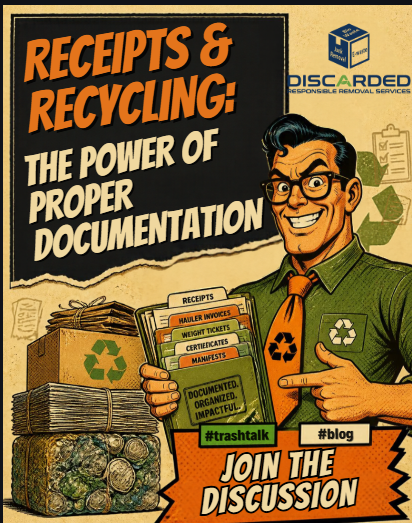
When you hire a Junk Removal Business, a simple paper or digital receipt is more than proof of payment. Proper documentation shows where your items went, how hazardous materials were handled, and that recyclable materials were routed to certified processors. For residents and businesses in New Haven County and Fairfield County, Connecticut, documentation supports compliance with local disposal rules, protects against liability, and helps with bookkeeping and tax records. At Discarded Responsible Removal Service (DRRS), we treat receipts and recycling records as part of our service — because responsible removal is responsible recordkeeping.
Top benefits of keeping receipts and recycling documentation
1. Proof of responsible disposal
A clear receipt or certificate of recycling shows that e‑waste, batteries, appliances, and hazardous items were handled by licensed recyclers. This protects property owners from accusations of illegal dumping and demonstrates environmental stewardship.
2. Data for bookkeeping and tax purposes
Receipts itemize services and disposal fees, which simplifies bookkeeping. Businesses can categorize junk removal as an operating expense; nonprofits and property managers can track disposal costs for budgeting and audits.
3. Chain of custody for sensitive items
Electronics and storage devices can contain sensitive data. Documentation that details secure data‑wiping or physical destruction of drives protects both the customer and the junk removal company.
4. Warranty and dispute resolution
If an item is lost, damaged, or not processed as promised, a dated receipt and service record make dispute resolution straightforward. They also document any special instructions (e.g., “remove and recycle refrigerator, door removed”).
5. Environmental transparency
Customers increasingly want to know whether their materials were recycled, refurbished, or landfilled. Documentation provides transparency and builds trust — a competitive advantage for a local Junk Removal Business.
What good documentation should include
When you receive a receipt or recycling record from Discarded Responsible Removal Service, look for these elements:
- Date and time of service.
- Customer name and address (service location).
- Itemized list of removed items (appliances, e‑waste, batteries, furniture, etc.).
- Weight or volume where applicable (e.g., cubic yards, pounds).
- Disposal method for each item (recycled, refurbished, hazardous‑waste processing, landfill).
- Destination facility (name of recycler or transfer station).
- Certificates for special handling (e‑waste recycling certificate, appliance decommissioning, data destruction).
- Technician or crew name and vehicle ID for chain‑of‑custody tracking.
- Payment method and transaction ID for bookkeeping.
Special focus: e‑waste and batteries
E‑waste and batteries require extra care. Proper documentation should show:
- Battery type and quantity (lithium, lead‑acid, alkaline, button cells).
- E‑waste serial numbers or device descriptions when data security is a concern.
- Proof of data destruction (certificate of data wiping or physical destruction).
- Recycling facility credentials — ensure the recycler is certified and follows environmental standards.
Keeping these records protects you from data breaches, hazardous material fines, and environmental liability.
How documentation supports local compliance in Connecticut
Connecticut municipalities and county programs often have specific rules for bulky waste, e‑waste, and hazardous materials. Documentation helps you:
- Meet municipal pickup requirements (proof you used a licensed service).
- Participate in town e‑waste events with proof of proper disposal.
- Provide records for property transactions (e.g., clearing a property before sale or lease).
- Demonstrate due diligence if a neighbor or inspector questions disposal practices.
At DRRS, we know the schedules and rules across New Haven County and Fairfield County and include the right paperwork with every job.
Best practices for customers: what to ask and keep
Before the crew arrives, ask your junk removal provider:
- Will I receive an itemized receipt and recycling certificate?
- Where will my e‑waste and batteries be taken?
- Do you provide proof of data destruction for drives and devices?
- Can you provide weight/volume documentation for business accounting?
After service, store receipts in a dedicated folder (digital or physical). For businesses, integrate disposal receipts into your bookkeeping system and attach them to the relevant expense entries.
How DRRS documents every job (our process)
- Pre‑job intake: We log the service address, items to be removed, and any special handling needs (e‑waste, appliances, hazardous materials).
- On‑site verification: Crew documents items removed, notes serial numbers for sensitive devices, and records weights/volumes when applicable.
- Transport tracking: We record vehicle ID and destination facility for chain‑of‑custody.
- Final paperwork: Customers receive an itemized receipt and, when applicable, certificates for e‑waste recycling or data destruction.
- Digital backup: DRRS stores service records securely for a defined retention period to support audits or customer requests.
Case study (illustrative)
A small clinic in New Haven County scheduled a commercial cleanout before relocating. DRRS provided an itemized receipt and e‑waste certificates showing secure data destruction for old computers. The clinic used these documents to satisfy its compliance officer and to claim disposal expenses in its accounting records — avoiding potential regulatory headaches and protecting patient data.
Common documentation mistakes to avoid
- Accepting vague receipts that don’t list disposal methods or destinations.
- Failing to request data‑destruction proof for devices that stored sensitive information.
- Discarding receipts — keep them for at least a year (longer for businesses).
- Assuming all recyclers are equal — ask for credentials and certificates.
Quick checklist for customers
- Request an itemized receipt and any applicable recycling certificates.
- Ask for data‑destruction proof for electronics.
- Keep receipts for bookkeeping and tax purposes.
- Verify the recycler’s credentials and destination facility.
- For businesses, attach receipts to expense entries and retain per your record‑retention policy.
Final thoughts
Documentation turns a routine junk removal into a responsible, auditable process. Whether you’re decluttering a home in Fairfield County or managing a commercial cleanout in New Haven County, the right receipts protect your privacy, finances, and the environment. Discarded Responsible Removal Service (formerly Discarded Junk Removal) combines hands‑on removal with transparent paperwork — so your space is spick and span and your records are in order.
0 Comments