For customers of Discarded Responsible Removal Service (formerly Discarded Junk Removal) — a practical, detailed guide for New Haven County and Fairfield County, Connecticut
1. Quick overview
Every year millions of devices — phones, laptops, printers, batteries, and more — are tossed out. What seems like a simple act of declutter can have a surprising and sometimes ugly end game. This post explains the e‑waste scandal, where old tech often ends up, the risks involved, and how Discarded Responsible Removal Service (formerly Discarded Junk Removal) helps homeowners and businesses in New Haven County and Fairfield County, Connecticut dispose of electronics responsibly.
2. What is e‑waste and why it matters
E‑waste (electronic waste) includes any discarded electrical or electronic devices. These items contain valuable materials (gold, copper) and hazardous substances (lead, mercury, cadmium). When e‑waste is handled properly it can be recycled safely; when it’s not, it becomes an environmental and human‑health problem. For a junk removal business, understanding e‑waste is essential — it’s not just hauling; it’s responsible handling.
3. The scandal in plain terms
- Hidden routes: Not all “recycling” is what it seems. Some electronics collected for recycling are shipped overseas or sold to middlemen. Once out of sight, tracking ends.
- Informal processing: In some places, e‑waste is dismantled by hand without safety controls. Workers — often in vulnerable communities — are exposed to toxic dust and fumes.
- Data risk: Old devices often still contain personal data. Improper disposal can expose sensitive information.
- False claims: Some companies advertise “eco‑friendly recycling” but only perform minimal processing or resell devices without proper data wiping or environmental safeguards.
These practices are the heart of the e‑waste scandal: good intentions or green claims that don’t match reality.
4. Where your old tech really ends up
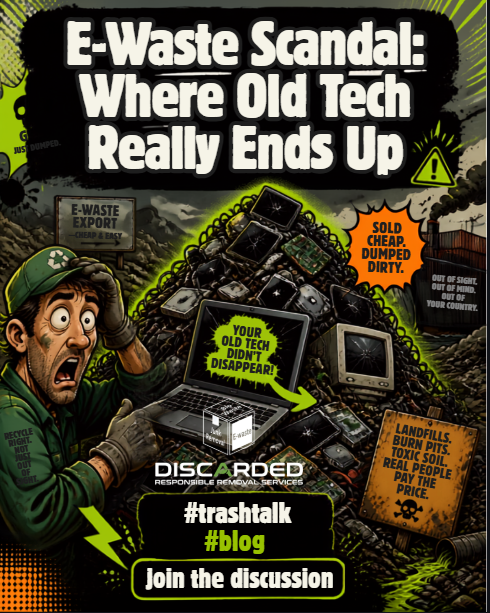
- Local landfill or incineration: When e‑waste is mixed with general trash, it can be buried or burned, releasing toxins.
- Export to informal recycling hubs: Devices are shipped to regions with weak environmental controls; there they’re often broken apart manually.
- Refurbish and resell: Some items are legitimately refurbished and resold — a positive outcome when done transparently.
- Parts harvesting: Usable components are stripped and sold; the remaining hazardous residue is discarded unsafely.
- Sitting in warehouses: Some collected e‑waste accumulates in storage, never processed, waiting for a buyer.
5. Risks to people, property, and planet
- Health hazards: Burning or acid‑based extraction releases heavy metals and dioxins.
- Soil and water contamination: Toxins leach into groundwater and farmland.
- Data breaches: Unwiped devices can leak personal and business data.
- Reputational risk: Businesses that don’t verify disposal chains can face public backlash.
- Legal exposure: Improper disposal can violate state and federal regulations.
6. How Discarded Responsible Removal Service handles e‑waste (what we do differently)
At Discarded Responsible Removal Service, we treat e‑waste as a special category — not just another item to haul. Our approach for customers in New Haven County and Fairfield County, Connecticut includes:
- Segregation at pickup: We separate electronics from general junk to prevent contamination.
- Verified partners: We work only with certified recyclers and refurbishers who provide transparent downstream tracking.
- Data security: For devices that may contain data, we offer secure data‑wiping or documented destruction options.
- Documentation: For businesses and institutions, we provide receipts and chain‑of‑custody records on request.
- Donation first: If an item is reusable, we prioritize donation to vetted local charities and community programs.
- Responsible disposal: Hazardous components are handled by certified processors to minimize environmental harm.
This is how a local junk removal business can be part of the solution rather than the problem.
7. Practical tips for customers (what you can do)
- Don’t toss electronics in the trash. Schedule a pickup or drop them at a certified e‑waste event.
- Wipe your data. Factory reset or use certified data‑destruction services before disposal.
- Ask for proof. If a hauler or recycler claims to recycle, ask for certifications and a chain‑of‑custody receipt.
- Donate when possible. Working devices can help families and schools — but only donate to reputable organizations.
- Separate batteries and cords. These require special handling.
- Use local services. Local providers like Discarded Responsible Removal Service (formerly Discarded Junk Removal) are easier to verify and hold accountable.
8. For businesses: compliance and reputation
If you run a business in New Haven County or Fairfield County, improper e‑waste disposal can be costly. Keep records, use certified vendors, and make e‑waste policies part of your procurement and disposal workflows. Transparency protects your customers and your brand.
9. Final thoughts
The e‑waste scandal is a reminder that disposal choices matter. When you declutter, you’re not just clearing space — you’re deciding the fate of materials and data. Choosing a responsible local partner like Discarded Responsible Removal Service helps ensure your old tech’s end game is safe, legal, and ethical.
Use up and down arrow keys to resize the meta box pane.
0 Comments